
What Was the Massive Late-Edo Project Tōkaidō Meisho Fūkei? Exploring the Appeal of Utagawa Toyokuni III’s Tōkaidō: Shinagawa
Date
In 1863 (Bunkyū 3), during the turbulent final years of the Edo period, an unprecedented collaborative project swept through Edo’s ukiyo-e world: Tōkaidō Meisho Fūkei (Famous Views of the Tōkaidō, also known as the Procession Tōkaidō).
Led by Utagawa Toyokuni III (Kunisada) alongside 16 of the era’s most popular artists—including Tsukioka Yoshitoshi, Ochiai Yoshiiku, Kawanabe Kyōsai, and Utagawa Hiroshige II—and 25 publishers, the competing studios produced over 160 large-format nishiki-e (full-color woodblock prints). From this monumental series, let’s take a closer look at Tōkaidō: Shinagawa, which depicts the very first post station after departing Edo.
Historical Background: Why Was Tōkaidō Meisho Fūkei Created? In February 1863, the 14th Tokugawa shogun, Tokugawa Iemochi, set out from Edo Castle for Kyoto with a massive retinue of roughly 3,000 retainers to strengthen ties with the Imperial Court (Kōbu Gattai, the union of the Imperial Court and the Shogunate). It was a historic event—the first time a shogun had traveled to Kyoto in 229 years, since the third shogun, Iemitsu.
Tōkaidō Meisho Fūkei was conceived to commemorate this grand shogunal procession. However, strict Edo-period censorship prohibited directly depicting the shogun or official shogunate events. To bypass this, the artists cleverly wove dazzling feudal processions and bustling travel scenes into the famous landscapes of the Fifty-three Stations of the Tōkaidō, capturing the public’s excitement and the turning tide of history without naming the shogun directly.
Highlights of Tōkaidō: Shinagawa by Utagawa Toyokuni III
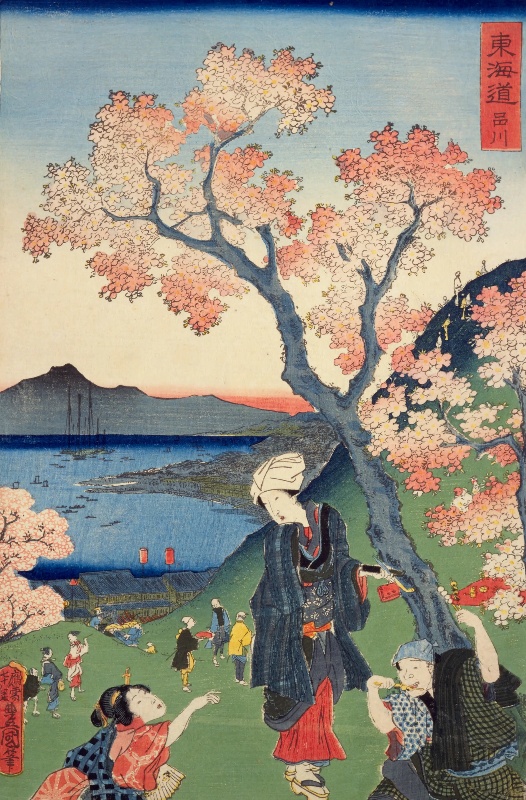
Among the prints depicting Shinagawa—the first stop after leaving Nihonbashi—is Tōkaidō: Shinagawa by Utagawa Toyokuni III (Utagawa Kunisada I).
As the leading figure in the ukiyo-e world at the time, Toyokuni III brought the vibrant brushwork he honed in yakusha-e (actor prints) and bijin-ga (portraits of beauties) directly into his landscape compositions.
The Bustling Energy of a Seaside Post Town
Facing Edo Bay, Shinagawa-juku was a scenic post town bustling day and night with travelers and crowds seeing them off or welcoming them back. In this print, Toyokuni vividly portrays both the grandeur of the procession moving along the highway and the lively atmosphere of the town set against the open seaside view.
Travel Sentiment and Iki (Edo Chic) in the Koma-e Inset
A signature feature of the Tōkaidō Meisho Fūkei series is the koma-e—a framed inset panel, usually placed in the upper portion of the print, showing a separate scene. In Toyokuni’s Shinagawa, contrasting with the grand procession on the road below, the inset captures a quieter, poetic evening moment: gazing out at the full moon from the tatami room of a seaside inn (hatago), a quintessential Shinagawa experience.
Enjoying a Showcase of Master Artists
The true thrill of Tōkaidō Meisho Fūkei lies in seeing how different artists brought completely distinct styles to the same highway—and even the same neighborhoods.
Even within the Shinagawa area alone, the series features scenes such as Shinagawa Yatsuyamashita, nearby Samezu (by Ochiai Yoshiiku), and Suzugamori (by Utagawa Hiroshige II). From Toyokuni III’s glamorous figure work to the dramatic compositions of Yoshitoshi and Yoshiiku, and the humor and dynamic brushwork of Kawanabe Kyōsai, the series brought together established veterans and rising stars in one lavish artistic showcase.
Tōkaidō Meisho Fūkei allows us to experience the excitement of Edo’s townspeople as they witnessed the historic news of the shogun’s journey to Kyoto. Marking the very beginning of that journey, Tōkaidō: Shinagawa remains a captivating print that conveys both the refined spirit of Edo and the swell of a changing era. Many prints from the series are available online through digital archives such as the National Diet Library Digital Collections and the Edo-Tokyo Museum—be sure to zoom in and explore every detail.