
[Ukiyo-e Guide] An All-Star Collaboration of the Bakumatsu Era! Exploring “Takanawa Ōkido” from the “Famous Views of the Tōkaidō” Series
Date
Published in 1863 (Bunkyū 3) during the turbulent Bakumatsu period, Tōkaidō Meisho Fūkei (Famous Views of the Tōkaidō), commonly known as the Gojōraku Tōkaidō (Procession to Kyoto along the Tōkaidō), is a monumental ukiyo-e print series. Created to commemorate the historic journey to Kyoto by the 14th Tokugawa Shogun, Tokugawa Iemochi, this lavish collaborative project brought together the greatest ukiyo-e artists of the era.
In this article, we will explore the historical background and artistic highlights of “Tōkaidō Meisho no Uchi: Takanawa Ōkido” (Takanawa Great Gate, from Famous Views of the Tōkaidō), the print that depicts the iconic starting point of this grand procession.
What is Famous Views of the Tōkaidō (Gojōraku Tōkaidō)?
In 1863, a Tokugawa Shogun traveled to Kyoto for the first time in roughly 230 years. This large-format nishiki-e (brocade print) series was planned to capture the excitement of that unprecedented event.
The defining feature of the series is its all-star lineup of Bakumatsu ukiyo-e masters:
Utagawa Toyokuni III (Kunisada) – The grandmaster of the ukiyo-e world
Utagawa Hiroshige II – A master of landscape prints
Tsukioka Yoshitoshi – The prodigy later hailed as the “Last Ukiyo-e Master”
Ochiai Yoshiiku – Yoshitoshi’s rival and fellow star pupil of Utagawa Kuniyoshi
Kawanabe Kyōsai – The eccentric genius celebrated for his comic and fantastical imagery
Including artists like Utagawa Sadahide and Utagawa Yoshitsuya, more than a dozen top artists contributed to this massive series of over 160 prints. Because directly depicting official shogunal affairs was strictly prohibited by censorship laws, the series was officially framed as “famous scenic spots along the Tōkaidō highway,” cleverly weaving the shogunal procession into the landscapes.
Commentary and Highlights of Takanawa Ōkido
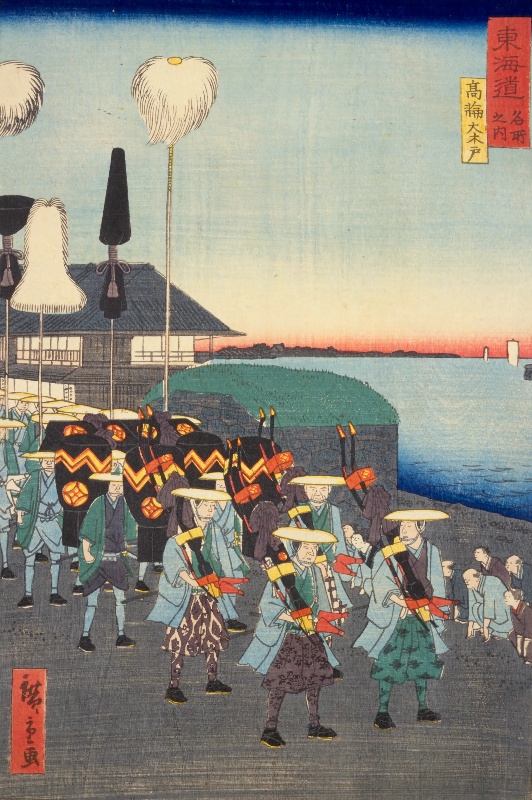
Tōkaidō Meisho no Uchi: Takanawa Ōkido is set at the “Takanawa Great Gate,” which served as the southern gateway to Edo (modern-day Tokyo).
1. Takanawa Ōkido: Marking the Start of the Journey
Located in modern-day Takanawa, Minato Ward (near Sengakuji Station), Takanawa Ōkido functioned as a checkpoint established to maintain public order and regulate traffic entering and leaving Edo. Thick stone walls (seen overgrown with grass in the center of the print) flanked the road, and wooden gates were closed at night to restrict passage.
It was also the traditional spot where locals gathered to see off travelers heading down the Tōkaidō. Within this series, it serves as the symbolic opening scene of the Shogun’s departure from Edo.
2. Sea and Procession: Utagawa Hiroshige II’s Composition
This particular print was designed by Utagawa Hiroshige II, the pupil and adopted son of the original Hiroshige. On the right side of the composition, the calm waters of Edo Bay (Tokyo Bay) stretch out, dotted with white sails and the daiba (artillery batteries) off the coast of Shinagawa in the distance. The warm reddish glow along the horizon, evoking dawn, blends seamlessly into the deep indigo bokashi (color gradation) at the top of the sky, capturing the crisp, invigorating atmosphere of an early-morning departure.
3. The Imposing Procession and Everyday Onlookers
Advancing in orderly ranks from the upper left toward the foreground, the procession gives the composition a strong sense of depth and rhythm:
Feathered Spears (Keyari) and Lacquered Boxes (Hasamibako): Tall white- and black-plumed spears and travel chests bearing family crests are rendered with meticulous detail, underscoring the prestige of the march.
Matchlock and Archer Corps: Samurai wearing conical hats (jingasa) and matching hanten coats carry firearms and bows. Their disciplined posture conveys a sense of gravity and late-Edo political tension far beyond a routine sankin-kōtai (alternate attendance) march.
Watching Townsfolk: In the lower right corner, ordinary townspeople kneel politely at the roadside with bowed heads so as not to obstruct the procession—offering a vivid glimpse into how everyday citizens experienced the historic event.
A Print Capturing a Historical Turning Point
While Tōkaidō Meisho no Uchi: Takanawa Ōkido showcases the serene beauty of Edo Bay alongside a stately procession, beneath its surface lies the immense historical undercurrent of the turbulent Bakumatsu era.
Among the many collaborative works in the Famous Views of the Tōkaidō series, this print stands out for both the anticipation of a grand journey’s beginning and Utagawa Hiroshige II’s refined, lyrical approach to landscape. Today, a portion of the original stone wall still survives at the Takanawa Ōkido Site in Minato Ward—making it well worth a historical stroll to compare the modern landmark with this timeless ukiyo-e masterpiece.