
Depicting the Gateway to Edo and Late-Tokugawa Energy: Exploring Tōkaidō: Honshiba Fudanotsuji from the Tōkaidō Meisho Fūkei Series
Date
In 1863 (Bunkyū 3), during the final years of the Edo period, a star-studded roster of ukiyo-e artists joined forces to create the collaborative print series Tōkaidō Meisho Fūkei (Famous Views of the Tōkaidō, also known as the Procession Tōkaidō). Featuring 16 popular artists—including Utagawa Toyokuni III (Kunisada), Tsukioka Yoshitoshi, Ochiai Yoshiiku, Kawanabe Kyōsai, and Utagawa Hiroshige II—this monumental series spanned over 160 prints and captivated the people of Edo.
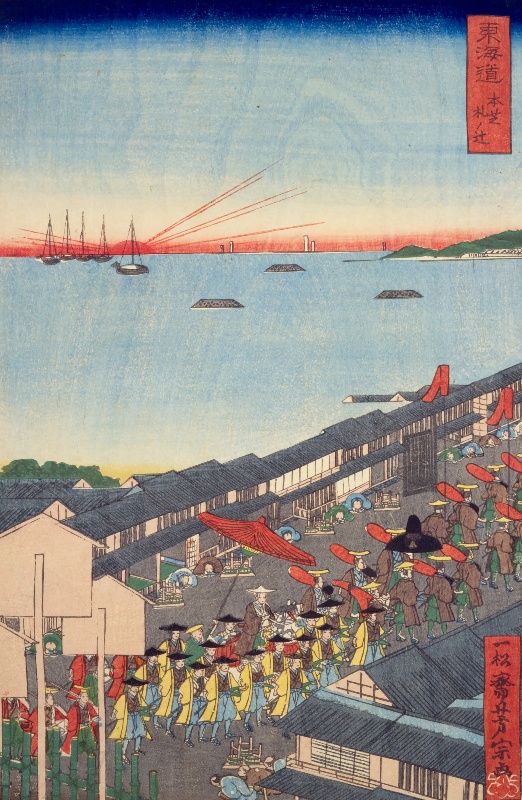
In this post, we focus on Tōkaidō: Honshiba Fudanotsuji, which depicts a historic spot in present-day Shiba, Minato Ward, Tokyo (near Tamachi Station), exploring both the history of the location and the highlights of the print.
What Kind of Place Was “Honshiba Fudanotsuji”?
Located around today’s Shiba 5-chōme in Minato Ward (near the intersection of Daiichi Keihin and Mita-dōri), Fudanotsuji was well known during the Edo period as a vital hub for transportation and public announcements.
Home to One of Edo’s Kōsatsuba (Notice Boards)
The name Fudanotsuji (literally “Crossroads of the Placards”) comes from the kōsatsuba—a roofed public bulletin board erected there to display official shogunate laws and decrees. Located near the southern boundary of Edo’s urban area along the Tōkaidō highway starting at Nihonbashi, it served as an important civic checkpoint.
Where the Sea Met the Highway
Immediately to the east stretched Edo Bay (modern-day Tokyo Bay), with the Tōkaidō running alongside a scenic coastline of white sand and green pines. For travelers setting out, it was the spot where the real journey began; for those arriving, it served as the gateway signaling they had finally reached Edo.
Highlights of Tōkaidō: Honshiba Fudanotsuji
Conceived against the backdrop of the 14th shogun Tokugawa Iemochi’s historic journey to Kyoto (the first shogunal procession to Kyoto in 229 years), the Tōkaidō Meisho Fūkei series bypassed strict shogunate censorship by portraying the excitement of the event through grand feudal processions and lively travel scenes rather than depicting the shogun directly.
Tōkaidō: Honshiba Fudanotsuji skillfully captures both the local landmarks and the electric atmosphere of the era:
The Iconic Kōsatsuba and Passing Processions
The composition features the roofed notice board that gave the area its name, alongside a stately procession advancing down the coastal highway. The contrast between the dignified retinue and the townspeople and travelers watching from a respectful distance conveys the heightened mood of late-Edo Japan.
Edo Charm in the Koma-e Inset
A hallmark of the series is the koma-e—a framed inset illustration typically placed in the upper section of the print. In this work, the inset complements the scene below with coastal views around Honshiba, local specialties of Edo Bay, or glimpses of everyday travel culture. The contrast between the solemn procession on the road and the peaceful daily life inside the koma-e is one of the unique pleasures of the series.
Following the Tōkaidō Through a Showcase of Master Artists
Tōkaidō Meisho Fūkei captures not only distant post towns, but also famous spots within Edo itself as the highway wound from Nihonbashi through Kyōbashi, Shiba, Takanawa, and Shinagawa.
Utagawa Toyokuni III’s vibrant, commanding portrayal of human figures
Tsukioka Yoshitoshi and Ochiai Yoshiiku’s dramatic, dynamic late-Edo compositions
Kawanabe Kyōsai’s humor and unmatched, expressive brushwork
Seeing each artist’s distinct personality shine through on a shared theme is the greatest appeal of the series. More than a mere landscape print, Tōkaidō: Honshiba Fudanotsuji preserves the breath of the era and the palpable sense that history was on the move.
Although today’s Fudanotsuji is a busy urban intersection flanked by office buildings and major roadways, gazing at Tōkaidō: Honshiba Fudanotsuji brings back the vivid memory of Edo—when the sea lapped right beside the road and feudal processions marched past. The print can be viewed online through digital archives such as the National Diet Library Digital Collections, making it easy to compare the Edo landscape with a modern map.