
Poetry Summoned by Radiant Blues and Summer Clouds: The Allure of Kawase Hasui’s Masterpiece “Lake Hamana”
Date
Often hailed as the “Hiroshige of the Showa era,” Kawase Hasui is a titan of the Shin-Hanga (New Print) movement whose poetic landscapes continue to captivate art lovers worldwide—including famous admirers like Steve Jobs.
Hasui traveled extensively across Japan, capturing the mood and shifting light of each region with deep lyricism. Today, we delve into “Lake Hamana” (Hamana-ko), one of his finest pieces from the renowned series Selection of Views of the Tokaido.
While Hasui is best known for his melancholic nocturnal scenes, quiet snowscapes, and rainy days, Lake Hamana stands out as a breathtaking departure. With its brilliant summer sunlight and striking blues, it is a uniquely radiant masterpiece in his body of work.
1. What is “Selection of Views of the Tokaido: Lake Hamana”?
Artist: Kawase Hasui
Year of Publication: August 1931 (Showa 6)
Series: Selection of Views of the Tokaido (Tokaido Fukei Senshu)
Format: Oban-size woodblock print (Shin-Hanga)
Publisher: Watanabe Mokuhan Bijutsu Gaho (Watanabe Color Print Co.)
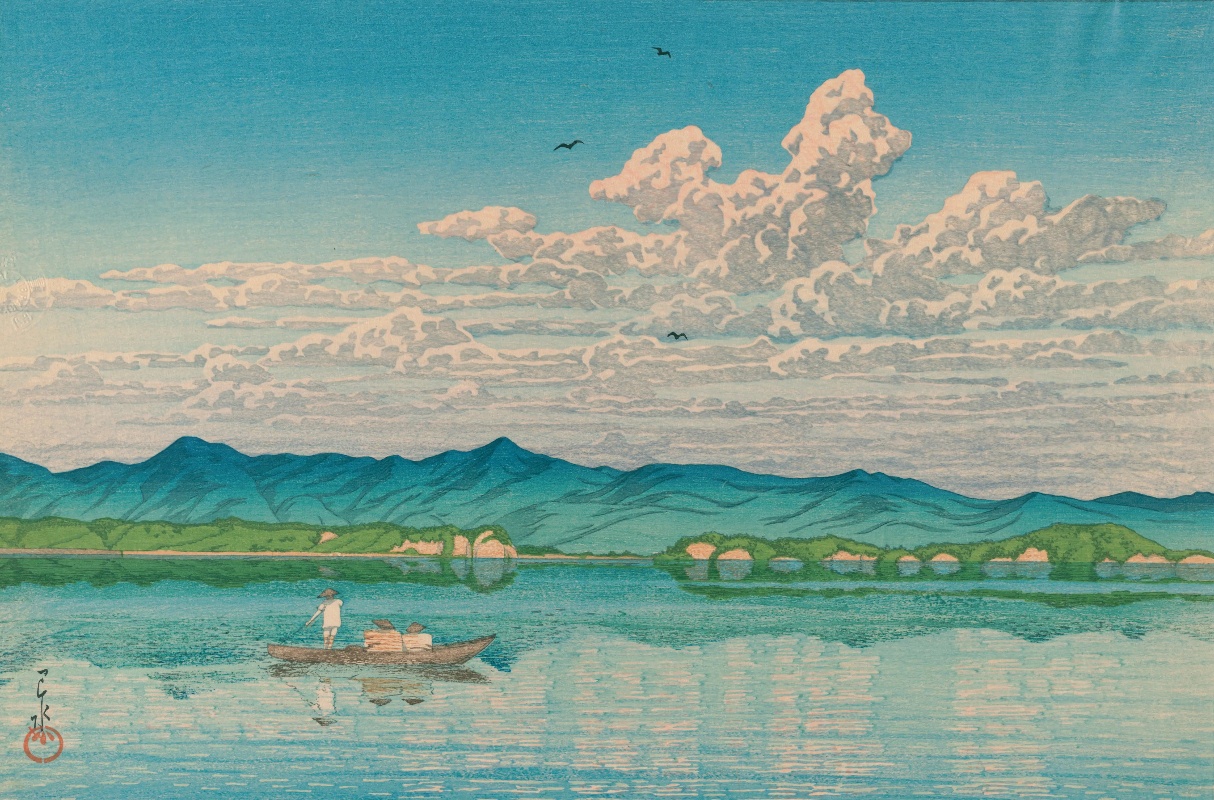
This print captures the tranquil waters of Lake Hamana in western Shizuoka Prefecture, framed by distant rolling mountains and dramatic, towering summer clouds rising into the sky.
2. Key Highlights: Three Features That Define “Lake Hamana”
① The Exquisite, Immersive “Hasui Blue”
The most striking element of this print is the deep, vibrant blue applied to the water and sky. Distinct from the traditional Prussian blue (“Berlin blue”) used in Edo-period ukiyo-e (such as by Utagawa Hiroshige), Hasui’s blues carry a modern depth and freshness. The subtle gradations (bokashi) reflecting the clouds and gentle ripples on the lake make you feel as though a cool, refreshing breeze is blowing right off the water.
② Dazzling Summer Clouds and Serene Sunlight
Dominating the upper section of the print, giant cumulus clouds glisten bright white under the intense summer sun. While Hasui’s landscapes are famous for the quiet beauty of falling rain or softly piling snow, the brilliant energy of summer light takes center stage here. Yet, despite the bright setting, a dignified quietude remains—a hallmark of Hasui’s sophisticated sense of color and impeccable composition.
③ Traditional Boats and the Spirit of Travel
A single traditional Japanese wooden boat floats peacefully across the still lake. Positioned against the vastness of nature, this small detail elevates the piece from a simple landscape sketch into a narrative moment. It evokes the feeling of a traveler pausing mid-journey to gaze out over a majestic, timeless vista.
3. The 1930s Era and Hasui’s Artistic Eye
The year 1931 marked a transitional period in Japan. Having rebuilt from the Great Kanto Earthquake of 1923, the nation was steadily modernizing.
While Hasui did depict modern sights and urban Tokyo, he harbored a deep affection for the unchanging natural beauty and quiet watersides encountered during his travels. He dedicated his life to preserving these scenes through the traditional medium of woodblock printing.
The bright, near-primary illumination featured in Lake Hamana is a characteristic charm of Hasui’s work in the 1930s, showcasing the mature height of the Shin-Hanga movement’s expressive power.
Summary
Kawase Hasui’s Selection of Views of the Tokaido: Lake Hamana is a magnificent work that harmonizes dazzling summer light with deep, crystal-clear water.
Offering a refreshing contrast to his soulful night and winter scenes, this print captures the grand, invigorating spirit of a Japanese summer. If you ever have the chance to see an original print in person, take time to lose yourself in the master craftsman’s flawless color gradations and the mesmerizing world of Hasui Blue!