
Modern Beauty Rising from the Dark: The Allure of Kawase Hasui’s Masterpiece “Kiyosu Bridge”
Date
Often celebrated as the “Hiroshige of the Showa era,” Kawase Hasui is a globally acclaimed titan of the Shin-Hanga (New Print) movement.
While Hasui is widely known for his nostalgic travel landscapes across Japan, his prints capturing the rapidly transforming urban scenery of Tokyo during the Taisho and Showa eras are equally revered by art enthusiasts.
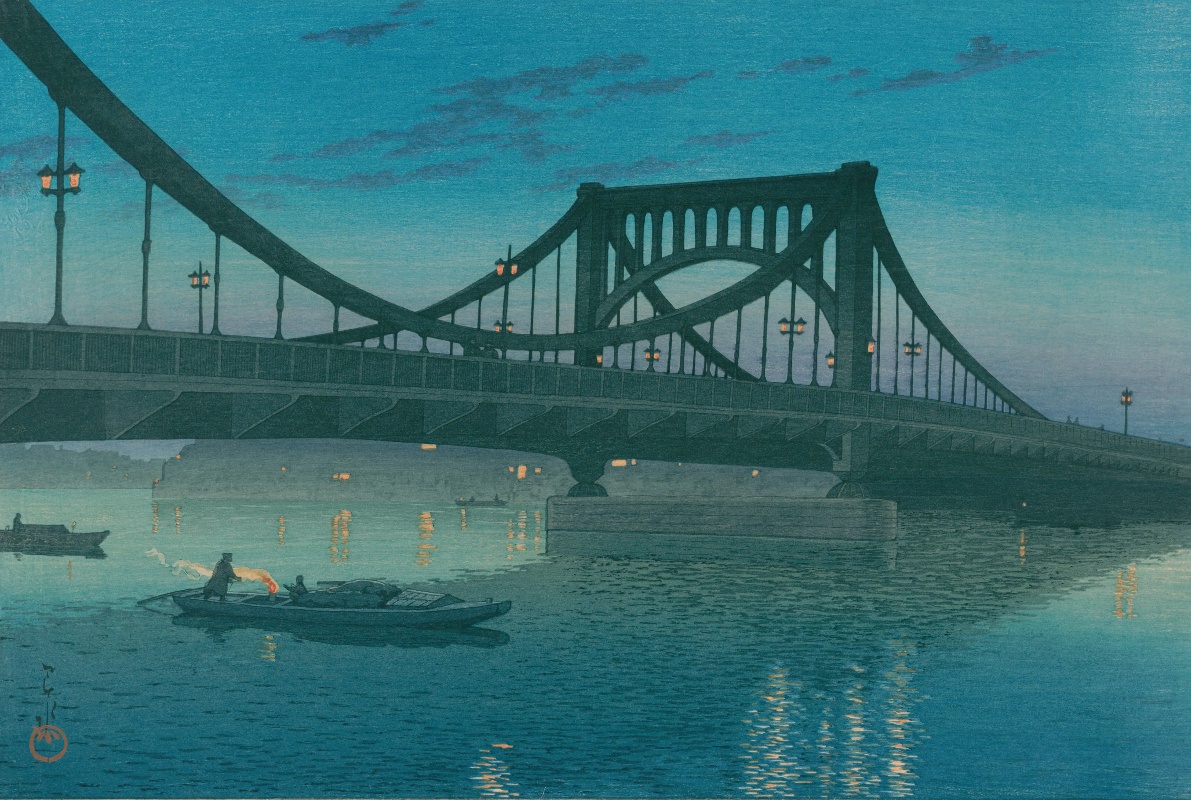
In this post, we explore “Kiyosu Bridge” (Kiyosu-bashi), a jewel from his celebrated series Twenty Views of Tokyo (Tokyo Nijukei), which captures both the spirit of post-disaster reconstruction and the modern elegance of 1930s Tokyo!
1. What is “Kiyosu Bridge”?
Artist: Kawase Hasui
Year of Publication: November 1931 (Showa 6)
Series: Twenty Views of Tokyo (Tokyo Nijukei)
Format: Oban-size woodblock print (Shin-Hanga)
Publisher: Watanabe Mokuhan Bijutsu Gaho (Watanabe Color Print Co.)
This print depicts a night view of Kiyosu Bridge, which spans the Sumida River connecting Chuo and Koto wards in Tokyo. Hasui brilliantly captures the graceful silhouette of the newly built suspension bridge against the deep midnight sky and shimmering river currents.
2. Key Highlights: Three Features That Define “Kiyosu Bridge”
① The Silhouette of the “Lady of Reconstruction”
Modeled after the Hindenburg Suspension Bridge over the Rhine in Cologne, Germany, Kiyosu Bridge was dubbed “The Lady of the Reconstruction” for its elegant, flowing steel curves. Hasui renders this massive, modern structure sharply against the night dark, transforming steel and rivets into a poetic work of art through the woodblock medium.
② Deep “Hasui Blue” and Reflections on the Water
Hasui’s mastery of nocturnal scenes shines in full force here. Deep navy tones (Hasui Blue) saturate both the sky and the Sumida River, evoking a serene midnight silence. The soft glow of streetlights along the bridge casts long, flickering reflections on the water, infusing the cool steel structure with warmth.
③ Merging Traditional Woodblock Craft with Modern Architecture
Unlike Edo-period ukiyo-e, which primarily focused on wooden bridges and traditional towns, Hasui embraces modern steel structures. Through delicate carving and subtle color gradations (bokashi), he infuses an otherwise industrial subject with profound lyricism and nostalgia.
3. Rebuilding Tokyo: Hasui’s Post-Earthquake Vision
The Great Kanto Earthquake of 1923 devastated Tokyo, destroying many of Hasui’s original woodblocks and sketches. Rising from this tragedy, Hasui embarked on his landmark series Twenty Views of Tokyo to document the city’s resilient rebirth.
Completed in 1930, Kiyosu Bridge stood as a triumphant symbol of a modern, restored Tokyo. In this print, Hasui captures not just a majestic bridge at night, but a quiet sense of hope and pride in a city reborn.
Summary
Kawase Hasui’s Kiyosu Bridge represents a breathtaking synthesis of “modern architectural beauty” and “traditional woodblock sentiment.”
Gazing at the graceful bridge standing quietly over the dark Sumida River, one can almost feel the cool evening air and the resilient spirit of 1930s Tokyo.