
Exploring “Nihonbashi” from the Scenes of Famous Places along the Tokaido Series
Date
Today, I’d like to introduce “Nihonbashi on the Tokaido” (Tokaido Nihonbashi), the starting point of the masterwork series Scenes of Famous Places along the Tokaido (Tokaido Meisho Fukei), created by a stellar lineup of leading Ukiyo-e artists at the end of the Edo period.
1. What is Scenes of Famous Places along the Tokaido?
In 1863 (Bunkyu 3), this series was published to coincide with a major historical event: the 14th Shogun Tokugawaga Iemochi’s journey to Kyoto (also known as the Gojoraku Tokaido or Gyoretsu Tokaido).
Top artists of the era gathered for this ambitious project, including Utagawa Toyokuni III, Tsukioka Yoshitoshi, Ochiai Yoshiiku, Kawanabe Kyosai, and Utagawa Sadahide. Together, they depicted the post towns and famous sights along the Tokaido highway.
Behind the grand procession symbolizing the Shogun’s authority, these works skillfully capture the lively scenes of Edo and the everyday life of ordinary people.
2. The Impact of Toyokuni III’s “Nihonbashi”
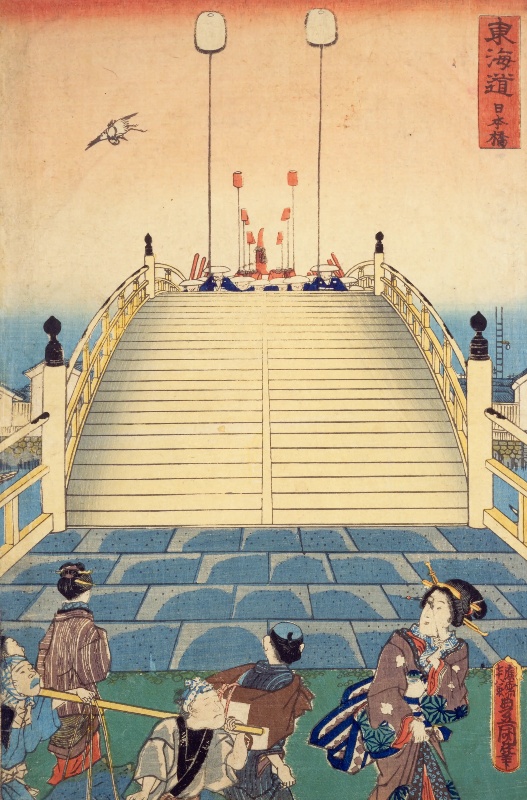
The featured piece, Nihonbashi, was created by Utagawa Toyokuni III (also known as Ichiyosai Toyokuni / Utagawa Kunisada), a master who stood at the peak of the Utagawa school.
The Looming Arch of Nihonbashi
What immediately catches your eye in this artwork is the bold angle of the arched wooden bridge positioned directly in the center. Captured from a low front-diagonal perspective, the dramatic foreshortening creates a striking contrast between the curve of the bridge and the straight lines of its steps.
The Shogun’s Procession Across the Bridge
Looking closely near the peak of the bridge, you can see the front of a grand procession carrying lanterns and spear banners. This scene vividly evokes the beginning of Shogun Iemochi’s historic journey.
Lively Edo Townspeople in the Foreground
In the foreground, everyday people are depicted with vibrant energy—a laborer carrying luggage, people in traditional kimono looking up at the bridge, and a woman looking back over her shoulder. In the sky above, a bird flies freely, enhancing the fresh morning atmosphere of a journey’s start.
3. Key Highlights
| Highlight | Description |
| Bold Composition | A dynamic layout dominated by the steep incline of the bridge. |
| Star-Studded Artists | A collaborative project led by Toyokuni III alongside rising talents like Yoshitoshi, Yoshiiku, and Kyosai. |
| Historical Context | Theme centered around the historic journey of the 14th Shogun, Tokugawa Iemochi, to Kyoto. |
Summary: Feeling the Energy of Edo
Unlike Hiroshige’s famous depiction of Nihonbashi in The Fifty-three Stations of the Tokaido, Toyokuni III’s rendition delivers a distinct sense of power through the bridge’s overwhelming central presence and the excitement of embarking on a grand journey.
It is a wonderful piece that conveys both the dynamism of the late Edo period (Bakumatsu) and the rich culture of the townspeople.
When visiting museums or exhibitions featuring the Scenes of Famous Places along the Tokaido series, be sure to pay attention to the unique artistic styles of each master!