
Poetic Serenity Woven by Majestic Mt. Fuji: The Allure of Kawase Hasui’s Masterpiece “The Fuji River”
Date
Hailed as the “Hiroshige of the Showa era,” Kawase Hasui remains a titan of the Shin-Hanga (New Print) movement whose poetic landscapes continue to captivate art lovers worldwide—including notable admirers like Steve Jobs.
Hasui traveled extensively across Japan, capturing the mood and seasonal changes of each locale with deep lyricism. Today, we explore “The Fuji River” (Fujikawa), one of his most celebrated and tranquil prints from his renowned series Selection of Views of the Tokaido (Tokaido Fukei Senshu).
Set along the quiet banks of the Fuji River with the sacred silhouette of Mt. Fuji rising in the distance, this print is a masterclass in stillness and natural majesty.
1. What is “Selection of Views of the Tokaido: The Fuji River”?
Artist: Kawase Hasui
Year of Publication: 1935 (Showa 10)
Series: Selection of Views of the Tokaido (Tokaido Fukei Senshu)
Format: Oban-size woodblock print (Shin-Hanga)
Publisher: Watanabe Mokuhan Bijutsu Gaho (Watanabe Color Print Co.)
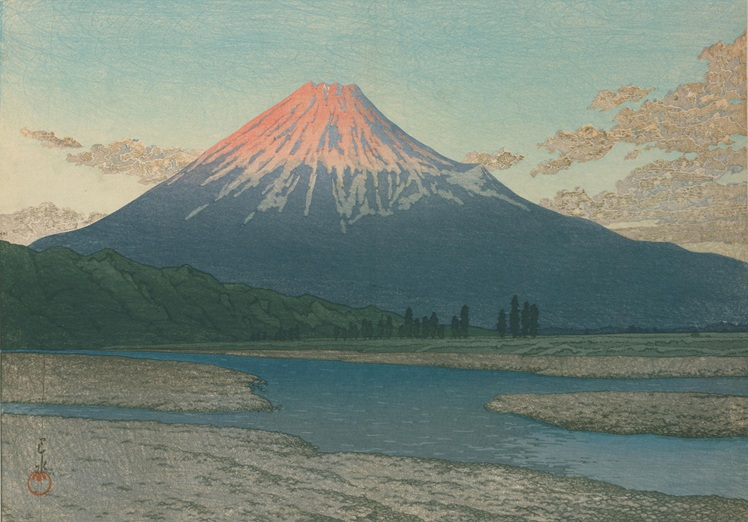
This print depicts a peaceful scene from the riverbank of the Fuji River in Shizuoka Prefecture, looking out toward the snow-capped peak of Mt. Fuji standing quietly against the horizon.
2. Key Highlights: Three Features That Define “The Fuji River”
① The Deep, Crystal-Clear “Hasui Blue”
The defining signature of Hasui’s work is his mastery of blue tones—often referred to as “Hasui Blue.” In The Fuji River, the exquisite color gradations (bokashi) applied across the clear sky and the gently moving surface of the river evoke a crisp, cold atmosphere. The minimalist composition places full focus on the purity of the water and air, creating a calming, soul-soothing effect.
② The Dignified Presence of Mt. Fuji
Crowned with pure white snow, Mt. Fuji rests in the background with divine quietude. Unlike the bold, dramatic graphic interpretations seen in Edo-period ukiyo-e (such as works by Katsushika Hokusai or Utagawa Hiroshige), Hasui’s depiction of Mt. Fuji is softer, gentle, and highly realistic, capturing the nostalgic essence of the mountain as held in the Japanese spirit.
③ A Still Waterfront Transfixed in Silence
In the foreground, the peaceful embankments and quiet shoreline stretch out without a single soul in sight. This complete absence of human activity enhances the immense scale of nature, making viewers feel as though they have paused mid-journey on a chilly morning to breathe in the crisp air and marvel at the timeless scenery.
3. The Mature Peak of the Shin-Hanga Movement
The 1930s marked the artistic height of the Shin-Hanga movement led by Hasui and publisher Watanabe Shozaburo.
Through the extraordinary skill of master woodblock carvers and printers, subtle details—such as the faint ripples on the river surface, the seamless sky gradations, and the tangible chill of early spring—were translated into print. The work stands as a triumph of combining traditional Japanese printmaking craftsmanship with Western principles of perspective and realistic light.
Summary
Kawase Hasui’s Selection of Views of the Tokaido: The Fuji River is a sublime masterpiece that harmonizes “the crystal-clear blues of sky and water,” “the quiet dignity of Mt. Fuji,” and “the serene poetry of untouched nature.”
Looking at this print transports you to a quiet riverside, inviting you to take a deep breath of the fresh, cold air while gazing upon Japan’s most sacred peak. If you ever have the chance to see an original impression, take a moment to admire the rich depth of its subtle blue gradations!