
[Exploring Edo Through Ukiyo-E] Visiting the Tokugawa Family Temple! An In-Depth Look at “Shiba Zojoji” from the Tokaido Famous Places Series
Date
Among the woodblock prints depicting the Tokaido road from Edo to Kyoto, did you know that a star-studded team of artists joined forces to create a massive series in 1863—during the final years of the Tokugawa shogunate?
That series is “Tokaido Meisho Fukei” (Famous Places Along the Tokaido, commonly known as Gojoraku Tokaido or Gyoretsu Tokaido).
Featuring a line-up of master printmakers who defined the late Edo and Meiji eras—including Utagawa Toyokuni III (Kunisada), Tsukioka Yoshitoshi, Ochiai Yoshiiku, and Kawanabe Kyosai—this series includes a notable piece highlighting a site deeply connected to the shogun’s lineage: “Famous Places of the Tokaido: Shiba Zojoji.”
1. What Kind of Place Was “Shiba Zojoji”?
“Shiba Zojoji” is the head temple of the Jodo sect of Buddhism and was deeply revered alongside Kaneiji in Ueno as a bodaiji (family temple) of the Tokugawa shogunal family.
When the 14th Shogun, Tokugawa Iemochi, embarked on his journey to Kyoto (Joraku)—the first visit by a sitting shogun in 229 years—visiting or passing through Zojoji held profound significance to pray for safety along the road.
Surrounded by lush green groves, the grand temple complex stood out as a serene and sacred sanctuary within the vibrant city of Edo.
2. Key Highlights of “Famous Places of the Tokaido: Shiba Zojoji”
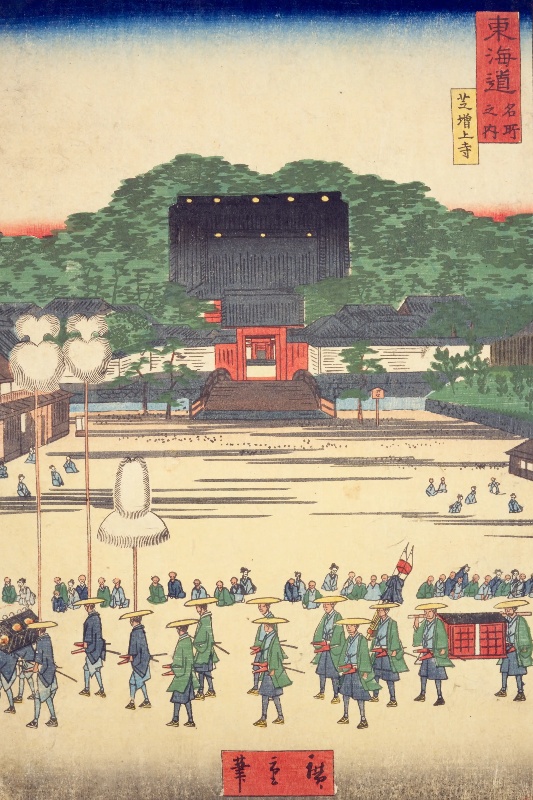
This artwork was created by Utagawa Shigenobu II (who later became Utagawa Hiroshige III). Here are key highlights where scenic beauty and the tension of a solemn parade coexist:
The Majestic Blend of the Red Gate (Sanmon) and Deep Green Hills
Standing prominently in the center is Zojoji’s striking vermilion main gate (Sangedatsumon), backed by the main hall and deep green forested hills. The contrast between the crimson morning sky, the rich green trees, and the vermilion gate captures the dignified prestige appropriate for a Tokugawa family temple.
The Formal “Feudal Lord Procession” of the Shogun’s Journey
In the open foreground, samurai wearing bamboo hats and formal garments march in quiet, orderly formation. Details like the long feather-topped spears (keyari) at the front, ceremonial sunshades, and high-status palanquins (kago) skillfully convey the gravity and discipline of this historic undertaking.
A Sweeping Sense of Space via Bird’s-Eye Perspective
By depicting the entire temple grounds from an elevated bird’s-eye perspective, the composition dynamically communicates both the vastness of Zojoji’s estate and the impressive scale of the procession.
3. The Artist Behind the Print: Utagawa Shigenobu II (Hiroshige III)
The creator of this piece, Utagawa Shigenobu II, was a disciple of Utagawa Hiroshige I, the famed master of landscape prints.
After changing his artist name, he eventually inherited the name Utagawa Hiroshige III. He was a skilled artist who inherited his master’s talent for capturing atmosphere while embracing the fresh visual aesthetics of late Edo and early Meiji landscape prints. In this series, he masterfully balances scenic charm with the placement of crowded figures.
Summary: A Print Conveying History’s Weight and Dignity
Among the works in Tokaido Famous Places, “Famous Places of the Tokaido: Shiba Zojoji” directly conveys the authority of the Tokugawa shogunate alongside the quiet tension of setting out on a long journey.
As you stand in the present-day grounds of Zojoji tucked beneath the shadow of Tokyo Tower, take a moment to imagine the marching footsteps of the shogun’s grand entourage as they moved through this very spot in 1863.