
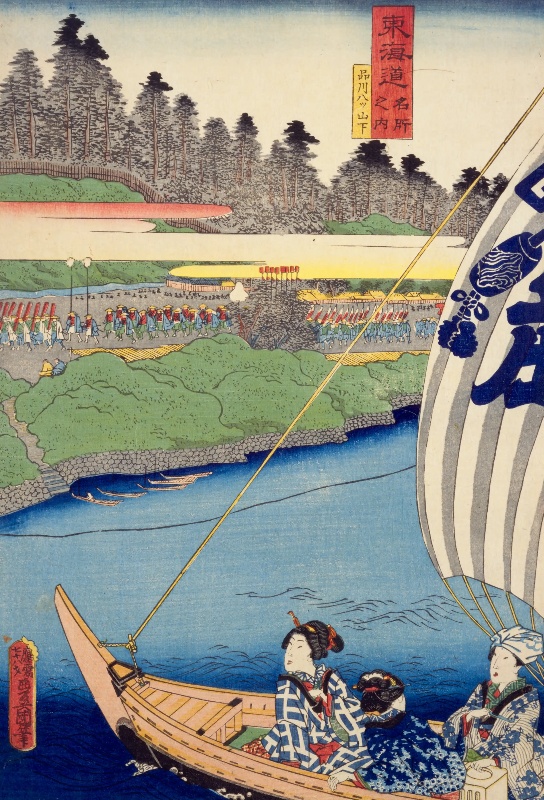
Panoramic Views of Edo Bay and a Bustling Post Town: Exploring Tōkaidō Meisho no Uchi: Shinagawa Yatsuyamashita from the Tōkaidō Meisho Fūkei Series
Date
In 1863 (Bunkyū 3), during the final years of the Edo period, 16 leading ukiyo-e artists and 25 publishers joined forces to create the unprecedented collaborative print series Tōkaidō Meisho Fūkei (Famous Views of the Tōkaidō, also known as the Procession Tōkaidō). Bringing together an all-star lineup—including Utagawa Toyokuni III (Kunisada), Tsukioka Yoshitoshi, Ochiai Yoshiiku, Kawanabe Kyōsai, and Utagawa Hiroshige II—this monumental series spanned over 160 prints and captivated the people of Edo.
In this post, we focus on Tōkaidō Meisho no Uchi: Shinagawa Yatsuyamashita, which depicts one of the most celebrated scenic landmarks right at the entrance to Shinagawa-juku, exploring the history of the site and the highlights of the print.
What Kind of Place Was “Shinagawa Yatsuyamashita”?
Located near the border of today’s Takanawa in Minato Ward and Kitashinagawa in Shinagawa Ward (around Yatsuyamabashi Bridge, just south of JR Shinagawa Station), Yatsuyamashita (“at the foot of Yatsuyama”) served during the Edo period as a major landmark right before entering Shinagawa-juku from the city of Edo.
A Coastal Headland with Spectacular Views
Yatsuyama was once a low hill and headland jutting out toward Edo Bay (modern-day Tokyo Bay), with the Tōkaidō highway hugging the shoreline at its base. Known as one of Edo’s finest scenic spots, it offered sweeping views of white-sailed boats across the blue bay and even the Bōsō Peninsula in the distance.
The Lively Gateway to Shinagawa-juku
After departing Nihonbashi and passing through the Takanawa Ōkido (Great Gate), travelers rounded Yatsuyamashita to reach Shinagawa-juku—the very first official post station on the Tōkaidō. Seaside teahouses lined the road, bustling day and night with travelers pausing to pray for a safe journey and Edo locals seeing off or welcoming loved ones.
Highlights of Tōkaidō Meisho no Uchi: Shinagawa Yatsuyamashita
Conceived against the backdrop of the 14th shogun Tokugawa Iemochi’s historic journey to Kyoto (the first shogunal procession to Kyoto in 229 years), the Tōkaidō Meisho Fūkei series bypassed shogunate censorship by depicting the excitement of the event through grand feudal processions and lively travel scenes rather than showing the shogun directly.
Tōkaidō Meisho no Uchi: Shinagawa Yatsuyamashita masterfully captures both the dramatic local topography and the electric mood of late-Edo Japan:
A Procession Winding Between Steep Bluffs and the Sea
The composition depicts a stately procession threading its way along the narrow coastal road between the steep bluffs of Yatsuyama and the open waters of Edo Bay. Making full use of this dramatic meeting point of land and sea, the print delivers a sense of scale and energy unique to Yatsuyamashita.
Edo Chic and Travel Sentiment in the Koma-e Inset
A signature feature of the series is the koma-e—a framed inset illustration typically placed in the upper section of the print. Here, the inset adds a contrasting perspective, such as local customs and specialties around Shinagawa or patrons relaxing in a seaside teahouse. The contrast between the formal procession on the highway and the leisurely, stylish everyday life inside the koma-e enriches the narrative of the print.
The Thrill of 16 Master Artists Competing in Tōkaidō Meisho Fūkei
The greatest appeal of Tōkaidō Meisho Fūkei lies in watching each artist’s distinct personality shine on the shared stage of the Tōkaidō highway:
Utagawa Toyokuni III’s glamorous, dignified portrayal of figures
Tsukioka Yoshitoshi and Ochiai Yoshiiku’s dramatic, dynamic late-Edo compositions
Kawanabe Kyōsai’s humor and unmatched, expressive brushwork
Even within the same Shinagawa area, comparing different perspectives—such as Tōkaidō: Shinagawa alongside Tōkaidō Meisho no Uchi: Shinagawa Yatsuyamashita—reveals the multifaceted charm of the landscapes Edo’s townspeople loved.
Although today’s Yatsuyamashita sits right beside the massive rail hub of Shinagawa Station and land reclamation has long since pushed back the shoreline, gazing at Tōkaidō Meisho no Uchi: Shinagawa Yatsuyamashita vividly brings back the late-Edo scene of processions marching in the sea breeze. Available online through digital archives such as the National Diet Library Digital Collections, it is well worth viewing alongside a modern map of Shinagawa.