
[The Beauty of Shin-hanga] A Rainbow over the Muted Sky: The Serene World of Kawase Hasui’s “Kaga Hatta, Souvenirs of Travel III”
Date
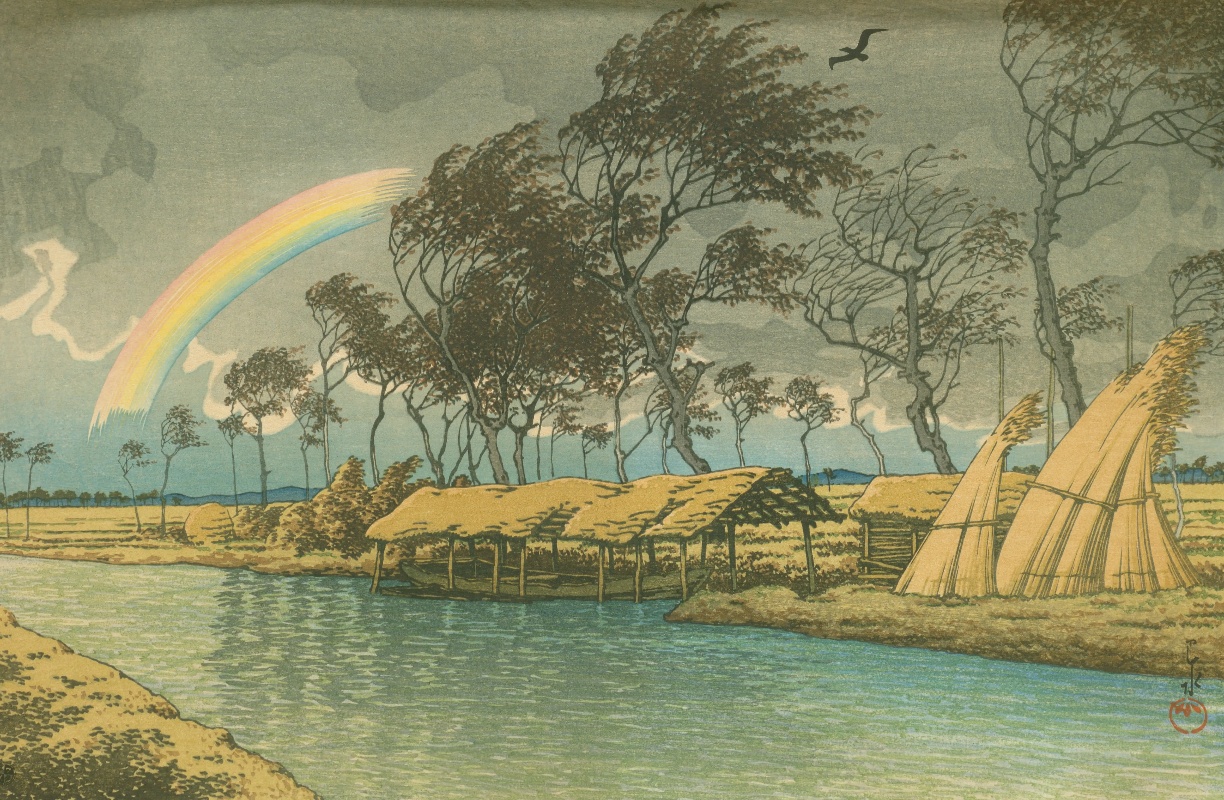
Known as the “Painter of Travel” and the “Hiroshige of the Showa Era,” Japanese woodblock print artist Kawase Hasui (1883–1957) created works that famously captivated admirers worldwide, including Steve Jobs.Among his iconic prints, we introduce Kaga Hatta, Souvenirs of Travel III (Tabi Miyage Dai-san-shū: Kaga Hatta), created in 1924 (Taisho 13) as part of his celebrated travel series.
Featuring a striking rainbow against a quiet, nostalgic Japanese landscape, this masterpiece holds a unique charm. Let’s dive deeper into its highlights and the tranquil atmosphere captured within the scene.
What is Kaga Hatta, Souvenirs of Travel III?
The Souvenirs of Travel (Tabi Miyage) series is one of Hasui’s defining works, produced in collaboration with the renowned publisher Shozaburo Watanabe (Watanabe Mokuhan-ten). Throughout the Taisho and early Showa periods, Hasui traveled across Japan, rendering the rich poetry and subtle beauty of the local scenery into woodblock prints.”Kaga Hatta” refers to the Hatta area, located in the northern part of Kanazawa, Ishikawa Prefecture today.
While Kanazawa is widely known for its historic castle-town heritage, Hasui chose to direct his artistic gaze toward the quiet, humble daily rhythm of the surrounding countryside.
Three Highlights of the Scene
Looking closely at the artwork, one is immediately drawn into its subtle, peaceful atmosphere.
A Seven-Colored Rainbow over the Overcast Autumn Sky
The most captivating element of this work is the vivid rainbow stretching across the upper-left sky. Against a heavy, low-cloud sky that suggests rain has just passed, the rainbow gracefully arches with a soft gradient. This demonstrates not only Hasui’s keen eye for capturing fleeting moments in nature, but also the extraordinary skill of the printmakers who translated it into a multi-color woodblock print.
Details Formed by Water and Wind
A river (or irrigation canal) flows gently through the center of the image. On its surface, the reflections of trees, thatched structures, and the sky’s subtle tones ripple delicately across the water. Additionally, the swaying branches of the trees and a lone bird flying overhead evoke the faint sound of a crisp autumn breeze sweeping through the air.
The Quiet Rhythm of Rural Life
Along the riverbank stands a thatched boat shelter, alongside stacks of harvested rice straw drying in the sun. Though no people are directly depicted, the presence and warmth of human life resonate softly, inspiring a sense of nostalgia and quiet comfort.
Why Do Hasui’s Landscapes Touch Our Hearts?
A gentle sense of solitude and melancholy often pervades Hasui’s landscapes.During the Taisho and Showa eras, Japan was rapidly modernizing and transforming its landscapes. Amidst these changes, Hasui lovingly sketched the quiet, vanishing rural scenery of traditional Japan.
A rainbow appearing in the sky after a sudden shower—it is precisely because these humble scenes are free from pretension that they evoke our own memories of distant travels and touch a universal sense of “home.”
In Conclusion
Kawase Hasui’s Kaga Hatta, Souvenirs of Travel III is a masterpiece that seamlessly blends damp, atmospheric beauty with a transient moment of natural splendor.
If you ever have the chance to view this work in an exhibition or art catalog, take a close moment to appreciate the delicate color gradations achieved through master woodblock carving and printing, as well as the gentle reflections upon the water.
Artwork Details
• Artist: Kawase Hasui (1883–1957)
• Title: Kaga Hatta, Souvenirs of Travel III (also known as Autumn Rainbow at Kaga Hatta)
• Date: 1924 (Taisho 13)
• Medium: Multi-color woodblock print (Nishiki-e)